April 21, 2026 · Rayen
Employee referrals that actually get you interviewed (without being weird)
Referral benchmarks, how to ask without being weird—and when you have no warm intro, how ApplyForMe Nearby employers surfaces local companies, public contact hints, and tailored resume, cover letter, and draft email (you send the mail).

Executive summary (TL;DR): Referrals are not magic and they are not nepotism dressed up as networking. They are a way to move your packet from "unknown in the ATS pile" to "someone on the inside can explain why you fit." This post pulls together what hiring-vendor data actually says about referrals, how to ask for a forwardable intro without making it weird, and what still has to be true about your materials once the intro lands. When you do not know anyone inside, Nearby employers in ApplyForMe gives you another path: companies near your profile address, contact hints surfaced from public pages, and one click to prepare application materials (tailored resume, cover letter, and a draft email you send yourself).
I used to treat referrals like a cheat code. You know someone who knows someone, you get a green path, you skip the line. After enough searches where even a warm intro died quietly in week three, I stopped believing that story. Referrals help because they add signal: a real human stakes a small piece of credibility on the idea that you might be worth a conversation. The interview bar does not disappear. The bar for getting the interview moves.
What the numbers say (and what they exaggerate)
Vendor reports are marketing plus data, so read the footnotes in your head. Still, the direction is consistent across sources: referred pipelines convert at rates job boards rarely touch.
Eqo, which sells referral-program software, publishes an annual benchmark built on aggregated customer data. In their latest write-up they cite figures like about 10 days faster time-to-hire for referral hires in their sample (they highlight healthcare-heavy organizations where that gap can look even wider) and strong early retention for referred hires compared with many other channels. Those numbers describe their customers' programs, not every company on Earth, but they match what recruiters say out loud in less polished forums: referrals are cheap to process, easy to trust at the resume stage, and painful to mess up because the referrer's name is attached.
Jobvite has long summarized referral outcomes for employers in similar terms: referrals can be a small share of applicants but a disproportionate share of hires, with faster cycle times than some job-board paths in the benchmarks they publish on their blog. Pinpoint, another ATS vendor, ran a larger application-level analysis and reported referred candidates several times more likely to reach an offer than job-board applicants in their data (the exact multiple varies by industry in their follow-on slices). None of these studies replace your own experience in a given market. They do explain why your LinkedIn DMs feel ignored while your former coworker's two-sentence forward sometimes gets a same-day reply.
Why a referral works when a cold apply does not
Recruiters are not evil; they are underwater. When hiring is slow, the weird part is not that they ignore you. It is that they still have to pretend the funnel is fine because the req is open. A referral does two boring jobs at once:
- It tells the team "this person is plausibly normal," which matters more than adults like to admit.
- It gives them a story for the hiring manager: "Sarah worked with them; she says they ship."
That is different from "I really want this job." Everyone wants the job on Monday. A referral answers a quieter question: would anyone who has actually seen you work vouch for you in a meeting?
The ask: short, specific, easy to forward
Here is where people turn into main characters on r/recruitinghell. Do not send a life story. Do not imply they owe you a career. Do not ask them to "just look at your profile" without naming a role.
Try a structure that fits in one scroll on a phone:
- One line of context: how you know each other, last time you worked together, or why you are reaching out now.
- One line on the role: company, title as posted, link to the req if it exists.
- One line on fit: not adjectives. A single proof point they can repeat ("I led the migration that cut login latency in half" beats "I am a passionate self-starter").
- Explicit permission to say no: "If you do not have bandwidth or the role is sensitive, zero pressure."
If they agree, send a forwardable blurb in the next message: three to five sentences in third person or first person, their choice, plus your resume link. You want them to paste, not rewrite your autobiography at 11 p.m.
What your referrer is actually risking
It is smaller than you think, but it is not zero. They are not promising you are brilliant. They are saying you are unlikely to embarrass them in a screen. That means you should protect their reputation: show up prepared, do not ghost the recruiter, do not badmouth the company if you withdraw. If you get an offer elsewhere, tell your referrer before the recruiter hears it from someone else. Small courtesies are how adults keep networks usable.
When referrals will not save you
If your resume does not match the posting in a way a stranger can see in 30 seconds, a referral becomes a favor that fizzles. If the company froze headcount, no intro overrides the budget. If the role is built for an internal candidate and the external post is compliance theater (we wrote about that pattern in our ghost jobs piece), a referral might only confirm what you already feared.
Referrals also sit in a tense place with diversity goals. Hiring teams know homogeneous networks reproduce homogeneous shortlists. Good programs still run referrals through the same bar assessments; the honest critique is that access to those networks is uneven. I am not going to pretend a blog post fixes structural inequality. I will say this: if you have a referral path, use it without apologizing for needing a job, and if you are asked to refer people, widen who you think of as "obvious."
Where ApplyForMe fits: referrals, tracking, and Nearby employers
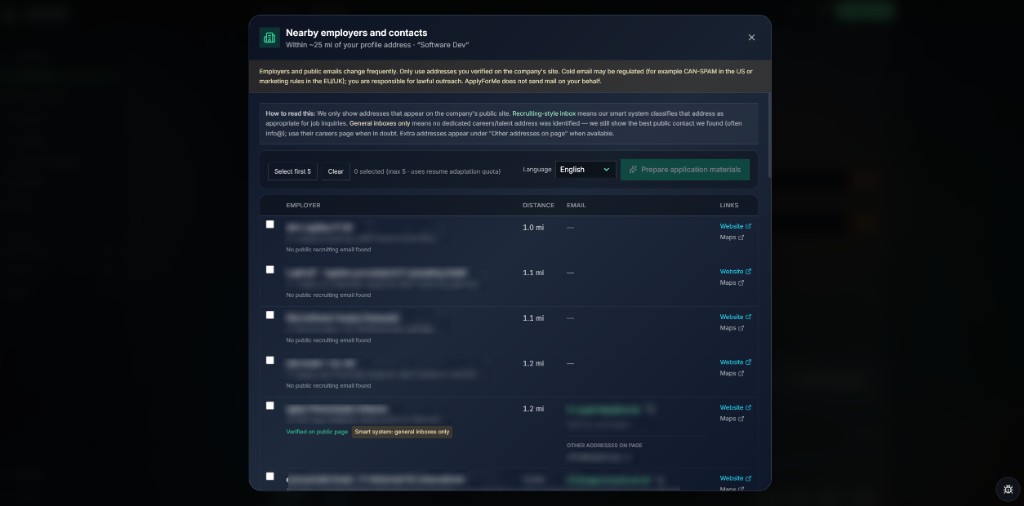
Alt text: ApplyForMe Nearby employers and contacts screen showing employers within miles of profile address, recruiting vs general inbox labels, compliance note that ApplyForMe does not send mail, and Prepare application materials.
Referrals do not replace tracking. They add another thread: who introduced you, which version of your resume went with that intro, whether you owe someone an update. When you are running parallel conversations, that context is easy to lose. ApplyForMe is built for that boring layer: what you sent, what you changed, what comes next.
When you do not have a warm intro, cold outreach to employers near you is a different game. The Nearby employers and contacts view starts from your profile location and a role lens (for example "Software Dev"), then lists employers within roughly twenty-five miles with distance, website and maps links, and whatever public email hints the product can justify. Rows call out when a contact looks like a real recruiting-style inbox versus a general inbox only, and the UI reminds you that outreach has to follow rules like CAN-SPAM or EU/UK marketing law—and that ApplyForMe does not send mail on your behalf. You pick who to talk to; you stay responsible for the send.
From there you can select employers (up to five at a time, tied to your resume adaptation quota), choose a language, and hit Prepare application materials. That run produces a tailored resume and cover letter plus a draft email you can paste into your own client, edit, and send when you are ready. It is the same spirit as a good referral packet: specific company, specific angle, something a human could defend—except the "intro" is yours to write and send.
FAQ
Is it unethical to ask for a referral if I barely know the person?
Ethics is a big word. Practically: weak ties can work if you are specific and low pressure. If you met once at a meetup five years ago, lead with that truth, ask for advice first, and accept a no. Mass-blasting "Can you refer me?" to everyone with a logo is how you get muted.
Do companies pay employees for referrals?
Often yes, with rules (timing, level, sometimes repayment if you leave early). That is between them and the employee. Your job is not to negotiate their bonus. Your job is to make the hire feel like a good decision.
What if they say they can only submit you through the official portal?
Do it exactly their way. Some places track compliance tightly. A "referral" that is really "employee submits candidate ID in Workday" still beats anonymous apply.
Should I mention I used AI on my resume or cover letter?
If the content is accurate and you can defend every line in an interview, the channel does not change the rule: do not ship fiction. If you cannot explain a bullet, delete it before anyone forwards it.
How long should I wait before nudging?
Give a week for busy people unless they gave you a timeline. Nudge once, politely, with new information ("I applied Friday; posting id is X") not with guilt.
Does a referral guarantee an interview?
No. It raises the odds in most datasets. Treat any promise of a guarantee as a red flag about the person promising it.
Does Nearby employers replace LinkedIn networking?
No. It is a parallel tactic: local employers, structured outputs, your own send button. Use it when geography and direct outreach fit your search.
Sources
- Eqo, The State of Employee Referral Programs in 2026: Key Insights & Benchmarks — https://www.eqorefer.com/annual-reports/the-state-of-employee-referral-programs-in-2026-key-insights-benchmarks
- Jobvite, 4 Reasons to Invest in Employee Referrals — https://www.jobvite.com/blog/4-reasons-to-invest-in-employee-referrals/
- Pinpoint, Referrals are 7x more likely to be hired than job board candidates — https://www.pinpointhq.com/insights/referrals-are-7x-more-likely-to-be-hired-than-job-board-candidates/
Next step: pick one target role this week where you have any plausible human connection, even second degree. Draft the forwardable blurb before you message anyone. If you cannot write it without squinting, fix the resume first—or open Nearby employers, pick two local companies with contact hints you trust, and run Prepare application materials once so you have a concrete packet to edit.