May 19, 2026 · Rayen
How to Align Your Resume With the Job Description
Match your jobs resume to the job description with proof-first bullets and honest keywords, not stuffing. ApplyForMe helps you tailor at scale.

Most people hear "align your resume with the job description" and picture keyword stuffing: paste the posting into a generator, spray the same phrases twelve times, hope the ATS blinks first. That is not alignment. That is noise with better formatting.
Alignment means a stranger can read your resume for thirty seconds and believe you might do this job, based on evidence you already have. The job description is the brief. Your resume is the proof packet. When those two line up honestly, you get more screens, fewer awkward interviews where you have to explain gaps you created yourself, and less time re-writing from scratch every Sunday night.
This guide is for anyone searching on "jobs resume" and meaning the pairing: one posting, one resume version, one clear story. We will decode what employers actually ask for, translate requirements into bullets you can defend, and build a workflow that scales without turning you into a fiction writer.
What "aligned" really means (and what it does not)
Aligned is not "mentions every noun in the posting." Recruiters and hiring managers are not playing word bingo. They are trying to answer:
- Can you do the core work in the first ninety days?
- Have you done something similar enough that the learning curve is reasonable?
- Will your resume still make sense if a human reads it after the software passes it along?
TalentTuner's ATS research whitepaper (aggregated resume-to-job scoring across large employer datasets) found that the average resume scores about 58% against a given job description, while many employers treat 70% as a practical pass line—and roughly three quarters of resumes land below that threshold before a person ever opens them. Those numbers are not a verdict on your worth. They are a reminder that generic master resumes underperform in filtered pipelines, even when the person behind them is qualified.
Alignment fixes the legibility problem: put the right proof where scanners and humans look first, use the employer's language when it matches your real work, and cut or demote anything that distracts from the role in front of you.
Misalignment looks like this:
- A resume written for "software engineer" submitted to a posting that is really "platform engineer with on-call and infra ownership."
- Skills listed alphabetically while the posting screams stakeholder management and compliance.
- Bullets full of adjectives ("dynamic," "results-driven") with no scope, action, or outcome.
You do not need a perfect match on every line of the posting. You need a credible overlap on the requirements that matter for shortlisting.
Read the job description like a hiring manager, not like a shopper
Before you touch your resume file, mark up the posting in three passes. Ten minutes here saves an hour of editing in the wrong direction.
Pass 1: Must-haves vs nice-to-haves.
Look for language that signals hard filters: "required," "must have," years of experience, licenses, work authorization, location or time zone, clearance, languages. Nice-to-haves often show up as "preferred," "bonus," or "ideally." If you miss a true must-have, no amount of tailoring fixes that role. Move on or park it on a watchlist, the way we describe in how to get a job faster without burning out.
Pass 2: The job's actual work.
Ignore the company mission paragraph for a moment. Underline verbs and outcomes: reduce churn, launch in EU, own roadmap, debug production incidents, coach junior analysts. Those verbs should appear in your bullets—only where you have done them.
Pass 3: Tools and domains.
Note specific stacks, regulations, customer types, and methodologies. These are the words ATS filters and recruiters search for. Mirror them when accurate; use honest umbrellas when you only have partial exposure ("familiar with Snowflake; primary warehouse experience in BigQuery").
| Posting signal | What to do on your resume |
|---|---|
| Repeated phrase in title + responsibilities (e.g., "customer onboarding") | Move your closest onboarding win to the top of the relevant role |
| Tool named as required | List it in Skills only if you can discuss it tomorrow; otherwise group under a truthful label |
| Vague "team player" fluff | Replace with one line of proof: cross-functional launch, conflict you resolved, stakeholder you aligned |
| Seniority mismatch ("lead," "principal") | Do not rename your title; show scope (budget, headcount, decision rights) in bullets |
If the posting feels copy-pasted or has been open for months with no updates, spend less time here. Our piece on ghost jobs and stale listings walks through when to downgrade effort before you rewrite a resume.
Build a requirement-to-proof map
Take a blank doc or a two-column table. Left column: requirements from the posting (grouped by theme). Right column: your evidence—projects, metrics, titles, tools.
Example for a B2B customer success role:
| Requirement from posting | Your proof (draft) |
|---|---|
| Own renewal pipeline for mid-market accounts | Managed 42 renewals ($3.1M ARR); improved on-time renewal rate from 81% to 89% in two quarters |
| SQL for health reporting | Weekly SQL dashboards in Postgres; cut manual reporting time ~6 hrs/week |
| Cross-functional launches with product | Led beta for billing export feature with PM + eng; 18 customers onboarded in 30 days |
Gaps are allowed. Mark them yellow. A yellow gap might mean "light exposure" or "adjacent skill." It should not mean "invent a bullet." Interviewers will probe the top third of your resume hardest; lies there waste everyone's time.
Jobscan's analysis of millions of applications (summarized in their State of the Job Search reporting) found large differences in interview rates when title and degree signals line up with the posting—not because credentials are everything, but because mismatched titles make parsers and humans hesitate. You cannot always change your title. You can add a clear headline or summary line that bridges: "Customer Success Manager (implementation-heavy) — B2B SaaS, renewals, SQL reporting."
The 30-minute alignment edit (without starting over)
Keep a master resume with every strong bullet you might need. For each application, duplicate the file and run this sequence:
- Headline + summary (2–3 lines). Name the target role and your best proof theme. No poetry.
- Reorder experience bullets so the first bullet under each job answers the posting's top priority.
- Swap synonyms where the employer's wording is standard in your industry (e.g., "incident response" vs "on-call remediation")—same meaning, their label.
- Trim unrelated wins that push relevant proof to page two. One page is still ideal for many roles; two is fine if every line earns its space.
- Skills section last. It exists for search and skimming, not to hide weak experience. Follow the discipline in our ATS resume checklist: plain section titles, no tables that break parsers, file named
FirstName-LastName-Role.pdf.
For a lighter pass on lower-priority roles, see how to tailor a resume to a job posting without exaggerating—same ethics, fewer edits.
Keywords: match meaning, not density
Applicant tracking systems vary wildly. Some rank keyword overlap; others mainly parse and store. Recruiters routinely filter on skills, education, and certifications in the ATS—Huntr's Q3 2025 job search trends report noted skills-based filtering as the most common filter type among surveyed recruiters.
Rules that keep you out of trouble:
- Use the exact tool name from the posting if you used that tool.
- Do not repeat the same keyword in every bullet; once near the achievement is enough.
- Never add skills to a block at the bottom that never appear in your experience.
If you are tempted to paste the entire job description into the footer in white text, stop. Modern systems flag gimmicks; humans find them embarrassing.
Tier your effort so alignment does not burn you out
Not every role deserves a full rewrite. Borrow the three-lane idea from the faster-job-search playbook:
| Lane | When to use it | Resume effort |
|---|---|---|
| Priority | Strong fit, company you care about, maybe a referral | Full alignment pass + human proofread |
| Standard | Good fit, realistic title band | Summary tweak + reorder top bullets + skills touch-up |
| Watchlist | Weak fit or shaky posting | Save posting; only align if you get a human signal |
In a muted 2026 market, precision beats volume. The 2026 job search playbook goes deeper on targeting when hiring is quiet; alignment is how you execute that targeting on paper.
Make the top third of page one do the heavy lifting
Recruiters skim. Hiring managers skim faster. The top third of page one should include:
- Role-relevant headline
- One summary line that states level + domain + signature outcome
- Most recent job title, dates, and first bullet that mirrors the posting's main pain
Ask a friend: "After ten seconds, what job do you think I'm applying for?" If they guess wrong, your alignment failed even if the rest of the page is strong.
Phone screens often start from that skim. If you earn a recruiter call, your stories should match what you emphasized—see the recruiter phone screen for keeping the narrative consistent.
Cover letters and referrals: alignment does not stop at the resume
A aligned resume plus a generic cover letter is half a packet. If you write a letter, one paragraph should map their stated problem to your proof, with a specific detail from their site or product. Our AI cover letters piece covers when automation helps and when it sounds hollow.
Referrals get you read more carefully, not forgiven for mismatch. Employee referrals that actually work assumes your materials already make sense for the role; alignment is what makes the referral easy to forward.
Track versions so you do not lose your mind
Every tailored resume should map to a posting ID, date, and filename. When you follow up a week later, you need to know which version went out. Spreadsheets work until they do not; our guide to tracking job applications lists what to log (stage, next action, which resume variant).
Naming convention that saves arguments with yourself:
2026-05-19_AcmeCorp_CustomerSuccess_RayenSmith.pdf
Where ApplyForMe fits
ApplyForMe is built for the loop this article describes: find roles worth your time, rewrite the resume against the actual posting, submit applications, and keep the pipeline visible so you are not rebuilding context every night.
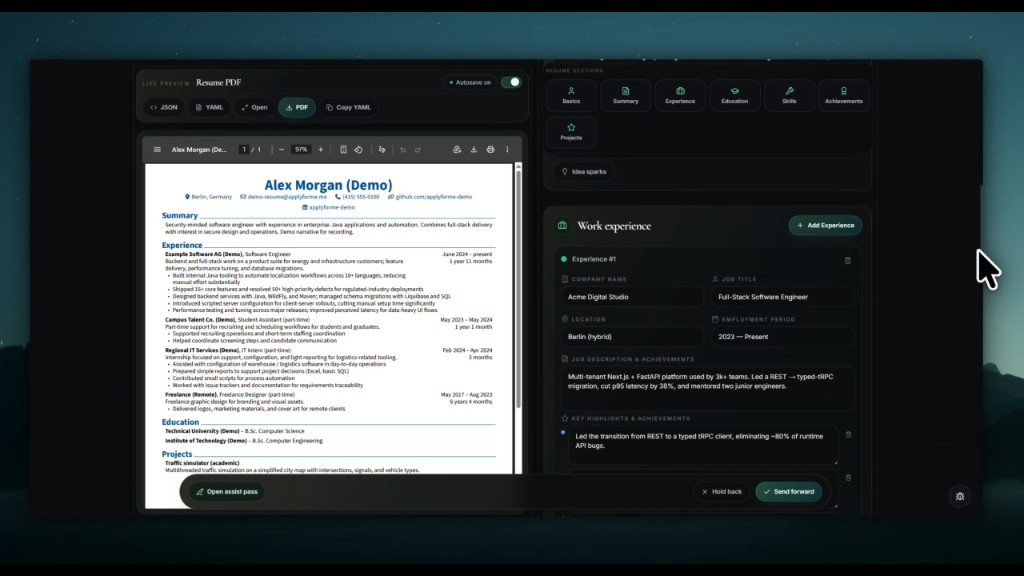
The product does not replace your judgment. You still approve what ships. The win is speed with guardrails—especially when you are running priority-lane alignment on several postings in one week without copy-paste errors or mystery versions.
If your current process is a master resume plus panic edits at midnight, join the ApplyForMe beta and treat alignment as a repeatable step, not a heroic one-off.
Frequently Asked Questions
How closely should my resume match the job description?
Aim for strong overlap on the top three to five requirements that define the role, honest coverage of tools you have used, and clear proof in the first bullets. Perfect word-for-word matching is unnecessary and often impossible without lying.
Will ATS reject me if I am missing one keyword?
Sometimes, if that keyword is a hard filter (specific certification, clearance, location). More often, weak overlap across many requirements pushes you down the stack. Check must-haves first before tailoring the rest.
Should I change my job title to match the posting?
Do not invent titles. You may use a concise headline that reflects how your work maps to their title (e.g., "Software Engineer — backend/platform focus") if your official title confuses readers.
How long should resume alignment take?
A priority role: 30–45 minutes once you have a master resume. A standard role: 10–15 minutes. If every role takes two hours, narrow your target list.
Is it okay to use AI to align my resume?
Yes, for drafting and reordering, if you verify every line. AI is bad at knowing what you have actually done. If you cannot defend a bullet in an interview, delete it.
Does alignment matter if I have a referral?
Yes. Referrals get you considered; alignment shows you are not wasting the interview slot.
Sources
- TalentTuner, ATS Research Whitepaper: Decoding the Black Box — https://talenttuner.app/research/whitepaper
- Jobscan, The State of the Job Search in 2025 — https://www.jobscan.co/state-of-the-job-search
- Huntr, Job Search Trends Report Q3 2025 — https://huntr.co/research/job-search-trends-q3-2025
- Bureau of Labor Statistics, Job Openings and Labor Turnover Survey (JOLTS) — https://www.bls.gov/jlt/
Next step: open one job description you care about this week. Highlight must-haves, build a two-column proof map, and change only five lines on your resume. Read the top third aloud. If it sounds like the posting's problem is your problem, you are aligned enough to send.