June 7, 2026 · Rayen
Career discovery tips when you're not sure what fits
Career discovery without the panic spiral: energy audits, three testable hypotheses, low-risk experiments, and a lane-based search system for when you do not know what job fits yet.

Executive summary (TL;DR): Not knowing what job fits is normal, not a personal failure. Career discovery works best when you stop treating "pick one forever" as the goal and start running small, low-risk experiments: energy audits, skill receipts, short conversations, and trial applications that teach you what to chase next. This guide turns that into a weekly system, with data on why so many workers feel stuck in 2026 and how to search without spraying random titles at the wall.
"I should know what I want by now."
That sentence shows up in career coaching threads, Reddit posts, and late-night Google searches more than almost any other. It also happens to be wrong in a very practical way. Most people do not wake up with a single clean vocation. They narrow a messy set of interests, constraints, and market realities over time.
Career discovery is that narrowing process. It is not a personality quiz that spits out one perfect title. It is closer to product research: you form hypotheses, test them cheaply, update your list, and repeat until the next step feels obvious enough to commit real hours.
If you are unsure what fits, the mistake is usually not lack of ambition. It is trying to solve a discovery problem with an application strategy built for people who already have a target.
Why "I don't know what I want" feels worse in 2026
Uncertainty is always uncomfortable. The current labor market makes it louder.
Gallup's Q4 2025 survey of U.S. workers found that 51% were either actively looking for a new job or watching for opportunities, while only 28% said now is a good time to find a quality job, down from about 70% in mid-2022. When the market feels tight, every open question about direction starts to sound like a luxury you cannot afford.
That pressure pushes people toward two bad defaults:
- Apply to everything remotely plausible and hope clarity arrives from volume.
- Freeze completely because choosing wrong feels scarier than choosing nothing.
Neither works well. Volume without a hypothesis teaches you mostly that rejection is random. Freezing protects you from a bad fit but also from the feedback that would help you choose better.
The BLS Career Outlook team has said for years that there is no single "right" way to start a career, and that flexibility to shift course is normal. That advice is aimed at high schoolers, but it applies at 35 too. Discovery does not end at graduation. It just gets more expensive when rent is due.
Reframe the question before you open job boards
Most career discovery advice starts with "follow your passion." That phrase is vague enough to be useless when you have several interests and one bank account.
Try these questions instead. They produce answers you can act on this week.
| Question | What it reveals | Example answer |
|---|---|---|
| What tasks give me energy even when they are hard? | Work you can sustain | Debugging a messy spreadsheet, teaching a coworker, writing clear docs |
| What tasks drain me quickly? | Roles to deprioritize | Cold calling, long unstructured meetings, repetitive data entry |
| What problems have I solved more than once? | Transferable proof | Onboarding chaos, broken handoffs, customer confusion at checkout |
| What constraints are real for the next 12 months? | Filters that prevent false starts | Caregiving hours, visa limits, salary floor, no relocation |
| What would "good enough for now" look like? | A bridge role, not a forever role | Stable remote ops job while I test product design on the side |
Notice what is missing: "What is my dream job?" Dream jobs are often assembled from movies, not Tuesday afternoons. Energy, proof, and constraints are observable. You can build a search around them.
If you want a broader read on why targeting beats panic applying once you have even a rough direction, see ApplyForMe's guide on how to get a job faster without burning out. The weekly structure there assumes you know roughly what lane you want. This post helps you find the lane.
Run a two-week energy and evidence audit
Before you rewrite your resume for the fifth time this month, spend ten days collecting data about yourself. Not journaling for hours. Short notes after real work.
Track three signals after any task longer than 30 minutes:
- Energy: Did I feel more awake or more depleted afterward?
- Competence: Did I know what to do next, or was I guessing the whole time?
- Impact: Did anyone care about the output?
Use a simple table on your phone:
| Day | Task | Energy (+/−) | Competence (+/−) | Impact (+/−) |
|---|---|---|---|---|
| Mon | Fixed billing bug | + | + | + |
| Tue | Status meeting | − | + | ? |
| Wed | Wrote help doc | + | + | + |
Patterns beat intentions. You might discover you like analytical work but hate the industry you are in. Or you like people-facing work but only when there is a clear problem to solve, not open-ended "relationship building."
That distinction matters when you translate discovery into titles. "Customer success" and "account management" can look similar on paper and feel completely different in practice.
Build three career hypotheses, not one destiny
Pick three directions that are plausible, not perfect. For each hypothesis, write one sentence:
- Hypothesis A: I might fit roles that combine data cleanup and stakeholder updates (operations analyst, implementation specialist).
- Hypothesis B: I might fit roles that emphasize teaching and documentation (trainer, technical writer, enablement).
- Hypothesis C: I might fit roles that emphasize building small tools (junior developer, automation specialist).
If you cannot name three, you are still in exploration mode. That is fine. Use adjacent titles from people whose weeks sound interesting on LinkedIn, O*NET job zones, or our 2026 job search playbook section on matching posting language honestly.
Then rank each hypothesis on four practical scores from 1 to 5:
| Hypothesis | Market demand near me | My existing proof | Time to become credible | Personal interest |
|---|---|---|---|---|
| A | 4 | 3 | 4 | 3 |
| B | 3 | 4 | 5 | 4 |
| C | 4 | 2 | 2 | 5 |
This is not science. It is a forcing function so you do not treat a fleeting interest in Python like a signed contract to become a software engineer next month.
Test hypotheses with conversations, not just courses
Online courses have their place. They are also easy to collect without changing your actual options. Conversations are cheaper feedback loops.
Aim for five informational chats over two weeks. Not "pick my brain" spam. Specific, respectful asks:
Hi [Name], I noticed your path from [X] to [Y]. I am exploring similar lanes and trying to understand what the week actually looks like. Would you be open to a 15-minute call about what you would optimize for if you were starting from [your background] today?
Most people ignore these. Some say yes. One good conversation can eliminate three bad hypotheses.
Questions that actually help:
- What did you think this job was before you started versus what it is now?
- What skills matter in the first 90 days?
- What kind of person struggles in this lane?
- If you were hiring someone with my background, what would make you say no?
Pair conversations with micro-experiments: volunteer for a project at work, freelance one small deliverable, shadow someone for an hour, contribute to an open-source issue, or build a portfolio piece that mirrors real tasks from postings you are considering.
You are looking for signal, not credentials yet.
When you are ready to search, use discovery lanes
Once you have rough hypotheses, job boards become useful again. Until then, they mostly create anxiety cosplay as productivity.
Borrow the three-lane system from faster job search playbooks, but tune it for discovery:
| Lane | Best for | Effort | Goal |
|---|---|---|---|
| Explore | Hypothesis roles where fit is unclear | Low | Learn posting language, required proof, salary bands |
| Target | Hypothesis roles where you meet most core requirements | Medium | Submit credible applications, track response patterns |
| Bridge | Stable roles that fund exploration | Medium | Pay bills while you gather evidence for a pivot |
This keeps you from treating every posting like a life decision. An explore-lane application might be a lightly tailored resume plus a note that you are pivoting and want to understand fit. A target-lane application gets the full treatment described in how to tailor a resume to a job posting.
If listings feel fake or stale, downgrade them before you invest an evening. Our post on ghost jobs and stale listings walks through quick viability checks so discovery does not turn into shouting into voids.
Translate discovery into resume language without faking a career
Pivoters often swing between two extremes: hide the past completely, or dump every unrelated job on page one.
Better approach: one bridge summary plus two proof blocks.
Your summary should name the direction you are testing and the evidence that transfers:
Operations specialist pivoting toward customer implementation roles. Three years owning onboarding workflows, SQL-based reporting, and cross-team rollout plans for 40+ accounts.
Your proof blocks should lead with outcomes that rhyme with the target lane, even if the employer logos differ:
- Reduced ticket backlog 30% by rewriting intake docs and training two support leads.
- Built weekly KPI dashboard used by sales and success teams for renewal risk.
You are not pretending you already had the title. You are making the through-line legible. Recruiters forgive pivots when the story is coherent and the receipts are specific. They struggle when the resume reads like a random playlist.
Run the ATS resume checklist once your bridge version exists. Discovery resumes still need to parse cleanly.
Protect momentum when clarity is slow
Career discovery can take months. That is normal and still annoying.
Use the cadence ideas from a sustainable job search when you still have a life: weekly anchors, modest totals, and recovery blocks you do not cancel when morale dips.
A realistic discovery week might look like this:
| Day | Focus | Output |
|---|---|---|
| Monday | Scan postings for hypothesis A and B | Save 8 roles, tag explore vs target |
| Tuesday | One conversation or outreach message | Book or send 2 asks |
| Wednesday | Micro-experiment or portfolio hour | One tangible artifact |
| Thursday | Apply to 1–2 target-lane roles | Tracked submissions |
| Friday | Review responses and update hypotheses | Kill one weak path, double down on one signal |
If nothing is working after three weeks, change the experiment, not your worth. Maybe your hypothesis is fine but your proof is thin. Maybe the lane is crowded and the bridge role needs more time. Maybe you need a referral path; employee referrals that actually work is a good next read once you have a short list of companies to investigate.
Where ApplyForMe fits
ApplyForMe is built for the operational layer of searching once you have even a fuzzy target: finding fresh listings that match your lane, tailoring resumes honestly, submitting applications, and tracking what happened next.
That matters during career discovery because you are running multiple hypotheses at once. Without tracking, you forget which resume variant went where, which conversation led to which interview, and which title families actually respond.
Used well, the platform lets you spend discovery time on conversations, experiments, and evidence, not on retyping the same work history into twelve portals. It does not pick your career for you. It keeps the search legible while you figure out the direction.
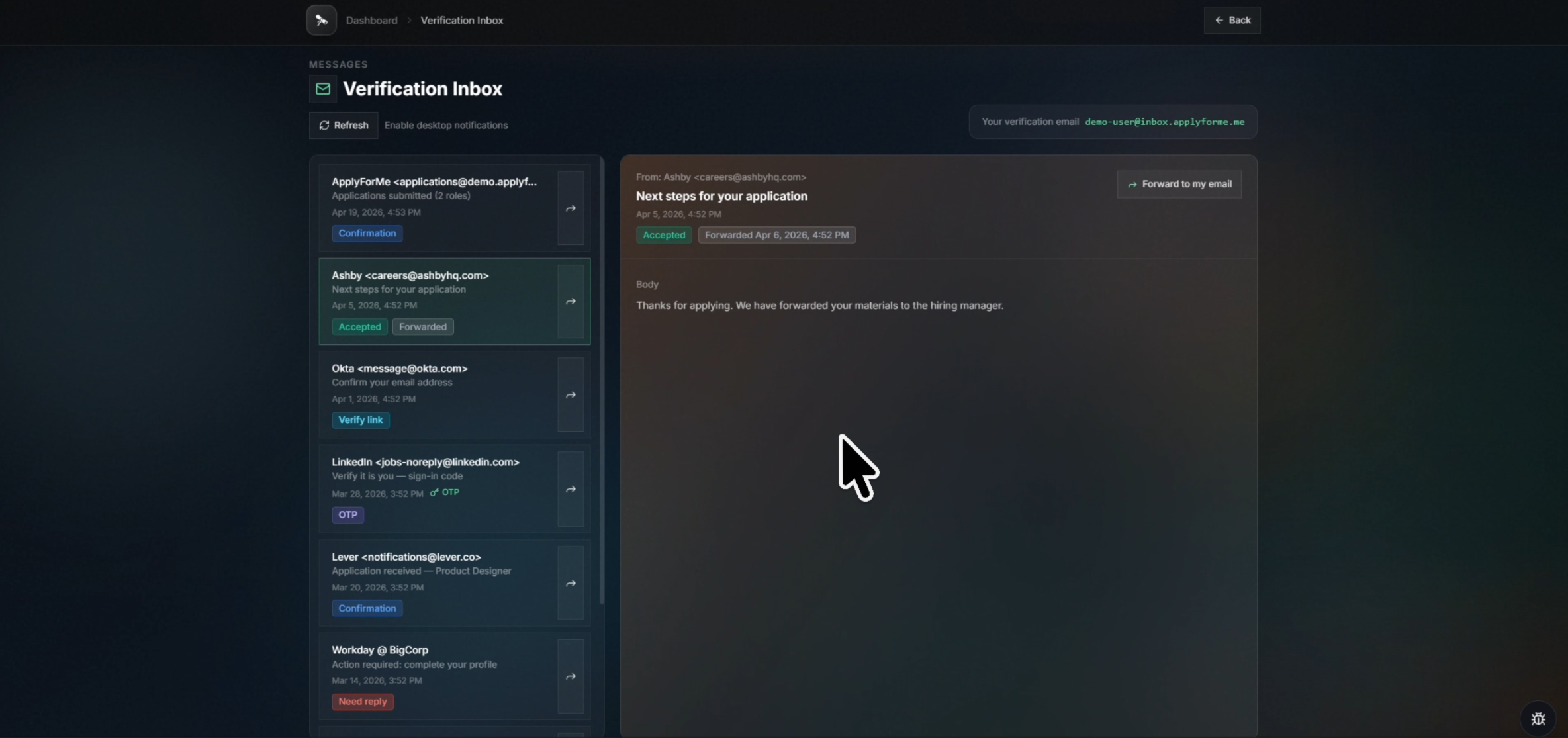
If a tool pushes you to blast applications before you can explain your pivot in one sentence, it is working against discovery. If it helps you compare response rates across hypothesis lanes, it is doing the right job.
Frequently asked questions
Is it too late to change careers in my 30s or 40s?
People change lanes at every age. The cost is real—time, sometimes income—but "too late" is usually a feeling, not a rule. Bridge roles and transferable proof matter more than whether you started in the "right" major at 19.
Should I take a career assessment test?
Assessments can spark ideas. Treat them as prompts, not verdicts. If a result surprises you, test it with a conversation or a small project before rebuilding your entire search around it.
How long should career discovery take?
There is no standard timeline. A focused two-week audit plus a month of targeted experiments gives most people clearer data than another year of vague browsing. If you are unemployed and under financial pressure, prioritize bridge income while running smaller experiments on the side.
Do I need a new degree to pivot?
Sometimes, often not. Many pivots move through certifications, portfolio work, internal transfers, or adjacent titles first. Read postings for your target lane and list the repeated proof employers ask for. That list tells you whether school is the shortest path or just the most familiar one.
What if I like two completely different paths?
Keep both hypotheses alive until evidence kills one. You might discover they converge (for example, design and research both show up in UX roles) or that one fits your constraints and the other does not. Parallel exploration beats premature commitment.
How do I explain a pivot in interviews?
Short, forward-looking, specific: what you learned, what you are moving toward, and one proof point that shows you have already started. Avoid apologizing for your past. Connect it.
Sources
- Gallup, U.S. Worker Thriving Declines as Job Market Pessimism Grows (Q4 2025 worker survey) — https://www.gallup.com/workplace/703280/worker-thriving-declines-job-market-pessimism-grows.aspx
- U.S. Bureau of Labor Statistics, Career Outlook, Career planning for high schoolers — https://www.bls.gov/careeroutlook/2015/article/career-planning-for-high-schoolers.htm
- Indeed Hiring Lab, January 2026 US Labor Market Update (context on selective hiring) — https://www.hiringlab.org/2026/01/22/january-labor-market-update-jobs-mentioning-ai-are-growing-amid-broader-hiring-weakness/
Next step: write three career hypotheses you could test in the next 14 days. For each one, schedule one conversation or one micro-experiment before you open a job board.
Ready to run discovery with a clearer pipeline behind you? Join the ApplyForMe beta and keep applications organized while you figure out what fits.